
Market Radar is a weekly read of what consumers want next and what marketers need next. AI agents scan the market every week, Adin.AI scores every trend, and our experts say what it means for brands. It is the first product in Adin.AI’s consumer intelligence suite, and it opened on 8 October.
The question that was nobody’s job
I have spent twenty years building companies around brands: Youth Republic, then YW, then Adin.AI, and in London, with my sister Seden, Brave New World. The hardest question in a planning meeting was rarely “what happened last quarter?” It was “what do people want next, and are we early or late?”
The answers usually existed. They were scattered across hundreds of research reports, surveys and search data, in many languages and many formats. Reading all of it, every week, was nobody’s job.
So we made it a job for AI agents, and put people on top of them.
Data is everywhere. But nobody can tell the signal from the noise. That was the first line of my post on launch day. It is still the shortest description of the problem.
What Market Radar shows
Two questions, answered every week, and a map of where they meet:
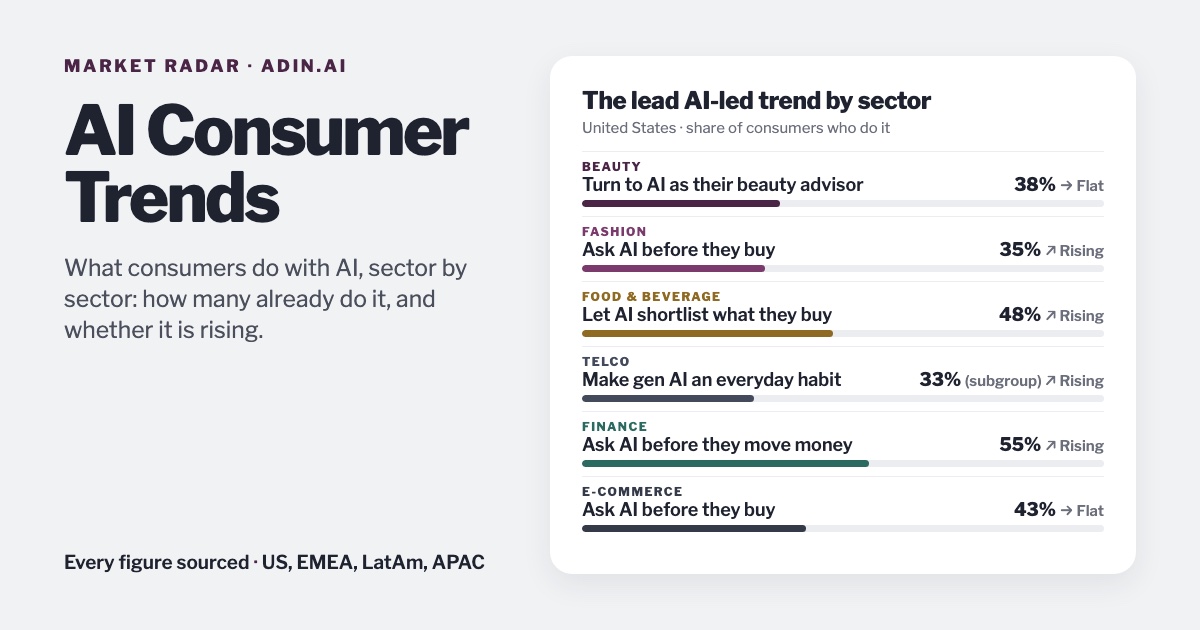
- What do consumers want next? AI Consumer Trends: 58 trends across six sectors (beauty, fashion, food and beverage, telco, finance and e-commerce) and four regions, each read for size, direction and confidence.
- What do marketers need next? Marketing Trends: what brand-side marketers need, by section and region, every demand scored from 0 to 100.
- Where are the blind spots? The Gap Map sets consumer trends against what marketers ask for, region by region, and shows where consumers are already ahead.
The data behind it
- 785 research reports covering more than 3 million consumers, plus official statistics, from 137 countries.
- 352 conversations with brand-side marketers at 239 brands.
- 3,000+ market signals from 250+ sources in seven languages, and 850+ brands tracked.
- 670,000+ data points in all, and 25 automated checks before anything goes live.
Every figure links to its original source. If we cannot show where a number comes from, it does not go on the radar.
What it already tells us
A few readings from the first edition (data as of 7 October 2026; all of them in Key findings):
- Consumers ask AI before they buy. It is the strongest consumer trend on the radar, with a Trend Strength of 84 out of 100 in e-commerce in APAC.
- Marketers want to be in the answer. The number one audience-insight need among US brand marketers is to be visible in AI assistant answers, scoring 82 out of 100.
- Saying is not doing. 57% of US consumers say they would let an AI agent check out for them; 13% have.
- The widest blind spot. In EMEA telco, 50% of consumers stay out of inertia, not loyalty, yet tracking brand health over time scores only 36 out of 100 among marketers.
From the first reports
Each report reads one shift in depth, with every figure linked to its source. Four of them:



Why consumer intelligence, and why now
Adin.AI started with media: helping marketing teams plan, manage and optimise advertising investment across markets, brands and channels. Then came creative intelligence, with Brave New World. Media was the left brain. Creative became the right.
What was still missing was the outside world: what consumers are about to do, before it shows up in campaign results. Market Radar brings that in. Media, creative and consumer intelligence now sit in one brain, on the same brand memory, so what a brand learns from the market can inform its next media and creative decision.
What marketers read first, and a report a week here
Since Market Radar opened on 8 October, the most read reports so far are AI Footprint, on how much of each consumer shift runs through AI, and Black Friday 2026.
With a Market Radar membership, you can start using it right away: every section, every report and the Gap Map. Every week I also share one of its reports on this site, in From the Radar.
Start with a Market Radar membership ↗