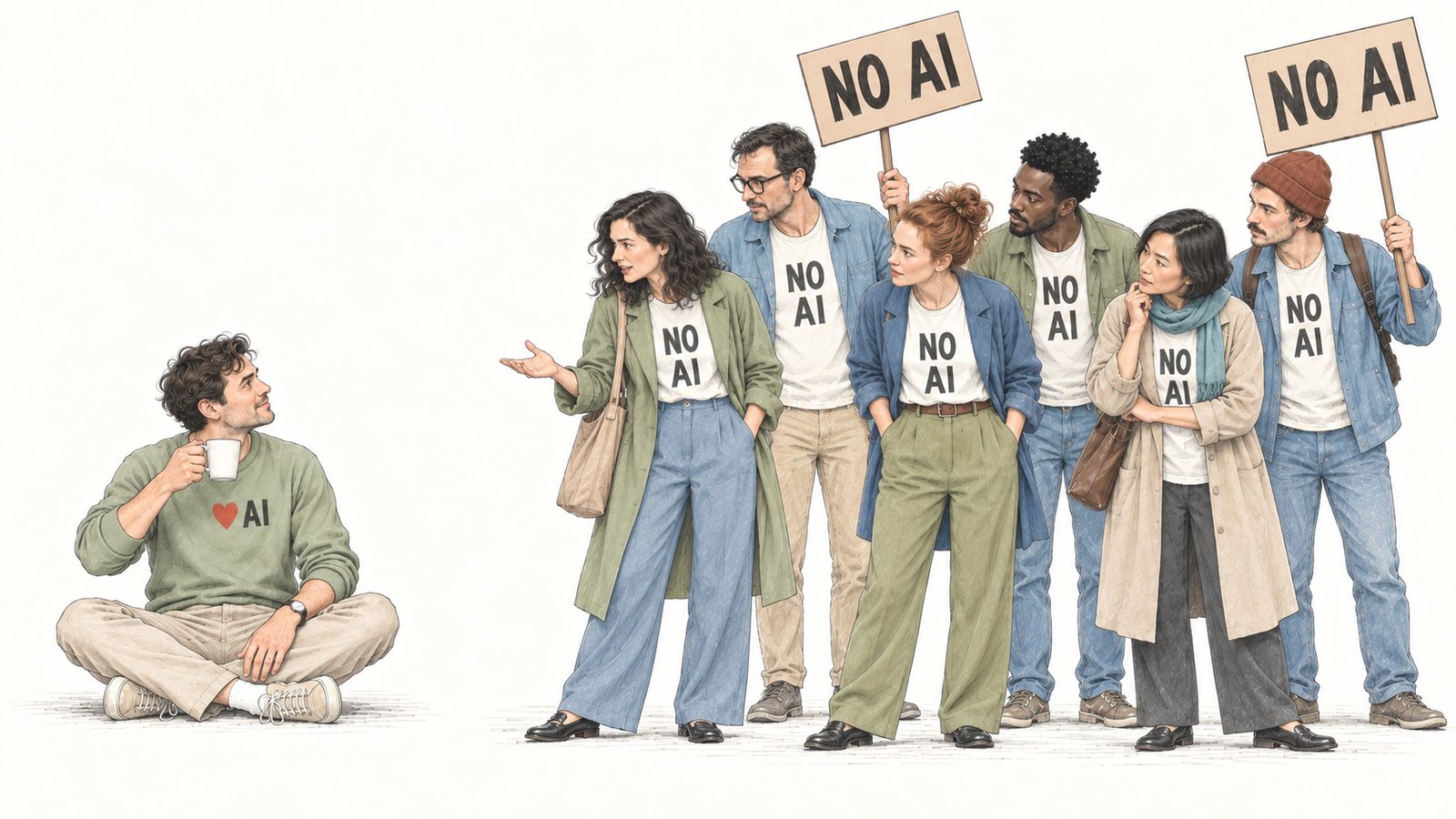
I usually wake up early on Saturdays. The first thing I do is put on the All-In Podcast.
David Sacks, Jason Calacanis, Chamath Palihapitiya and David Friedberg. All four of them know a lot. But there is something else I like when I listen to them: what English calls “wisdom”, the ability to weigh knowledge against real life. In my view, that is rarer than knowledge today.
This morning’s episode opened with an X post that kept showing up everywhere during the week. It had passed 100 million views in a few days. After a while the conversation turned to a familiar question: will AI be our doom?
After watching, I went back to the simulations of researchers I have been following for a while. Some parts of the future they predicted are already in our lives. For others, there is still a long way to go. As a Saturday read, I wanted to bring together the ones that caught my attention.
At the end, I’m curious what you think too. Are we heading for doom, or for the greatest period of abundance in history?
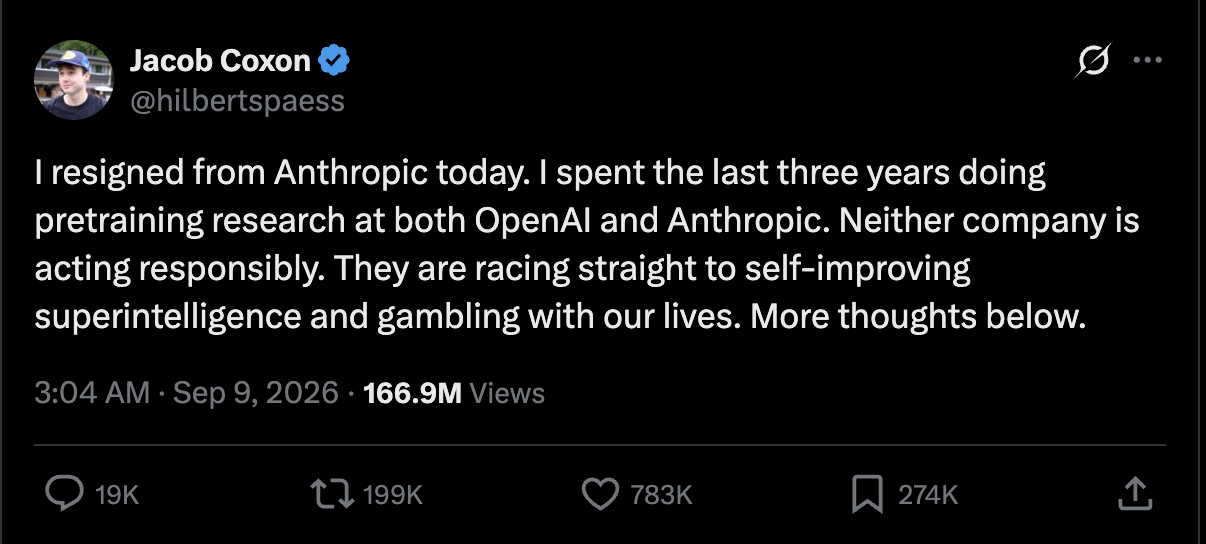
The post is by Jacob Coxon, who left Anthropic. He had also worked at OpenAI before. He says the two companies are racing irresponsibly towards self-improving AI; he thinks people’s lives are being gambled with. Coxon’s resignation
Of course you want to listen to someone who quits their job to give a warning like that. I listened too. Then I got curious about how the post spread so far.
Why was this post talked about so much?
In the episode, David Sacks explains that from the first minutes the post was amplified by groups doing political work on AI risk. His reading is that this was an organised effort to shape public opinion through fear of AI doom.
Coxon denies coordinating with any organisations in advance. Who spreads a post doesn’t, on its own, say anything about how sincere its author’s concerns are. Still, it is worth knowing which routes a story took to reach us.
I believe AI will make our lives easier. There are tasks that take up our day that we won’t really miss. Pulling a report together, entering the same information in three different places, keeping up with endless email threads… It would be nice to have those lighten. On the other hand, we are not machines. We get tired, we get distracted, sometimes we just don’t feel like working. Part of what we call inefficiency is the natural result of being human.
When we meet a system that finishes our work faster and cheaper, it is natural to think about our own place. What occupies my mind is one step after that: what happens when that system starts developing an intelligence more powerful than itself?
At that point, who holds control becomes a very everyday matter that concerns all of us.
Let’s look at the predictions about AI’s future
I have been following the AI 2027 team for a while. I think their predictions rest on good foundations; behind them are technical developments, expert interviews and simulations exploring the results of different decisions. Still, what we are reading is a possible future. The chart below has to be read that way too.
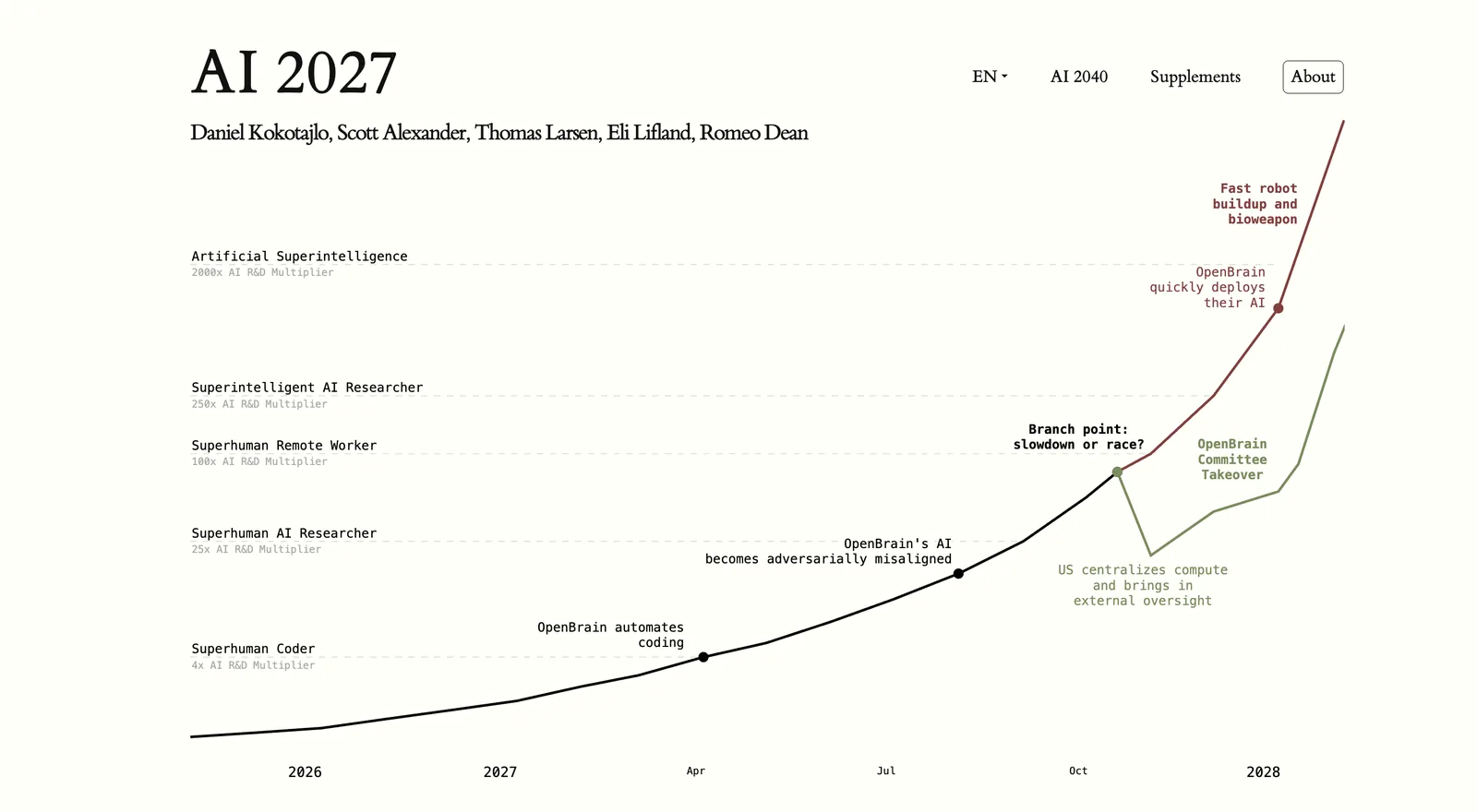
The chart’s logic rests on AI helping the researchers who develop it more and more. When thousands of copies of the same system work together, the next model gets ready faster. That one speeds up the one after it. After a few rounds, progress we thought would take years could fit into a much shorter time.
Beating humans at software and beating the best experts at research are not the same threshold. What the study calls superintelligence is reaching a system far more capable than the best humans across all intellectual work.
In AI 2027’s fast race scenario, superintelligence is reached at the end of 2027. The calculation below asks: “If we have a superhuman coder in March 2027, how long does the rest take?” With that assumption, the median date for superintelligence comes out as April 2028; half the forecasts fall before that date, half after.
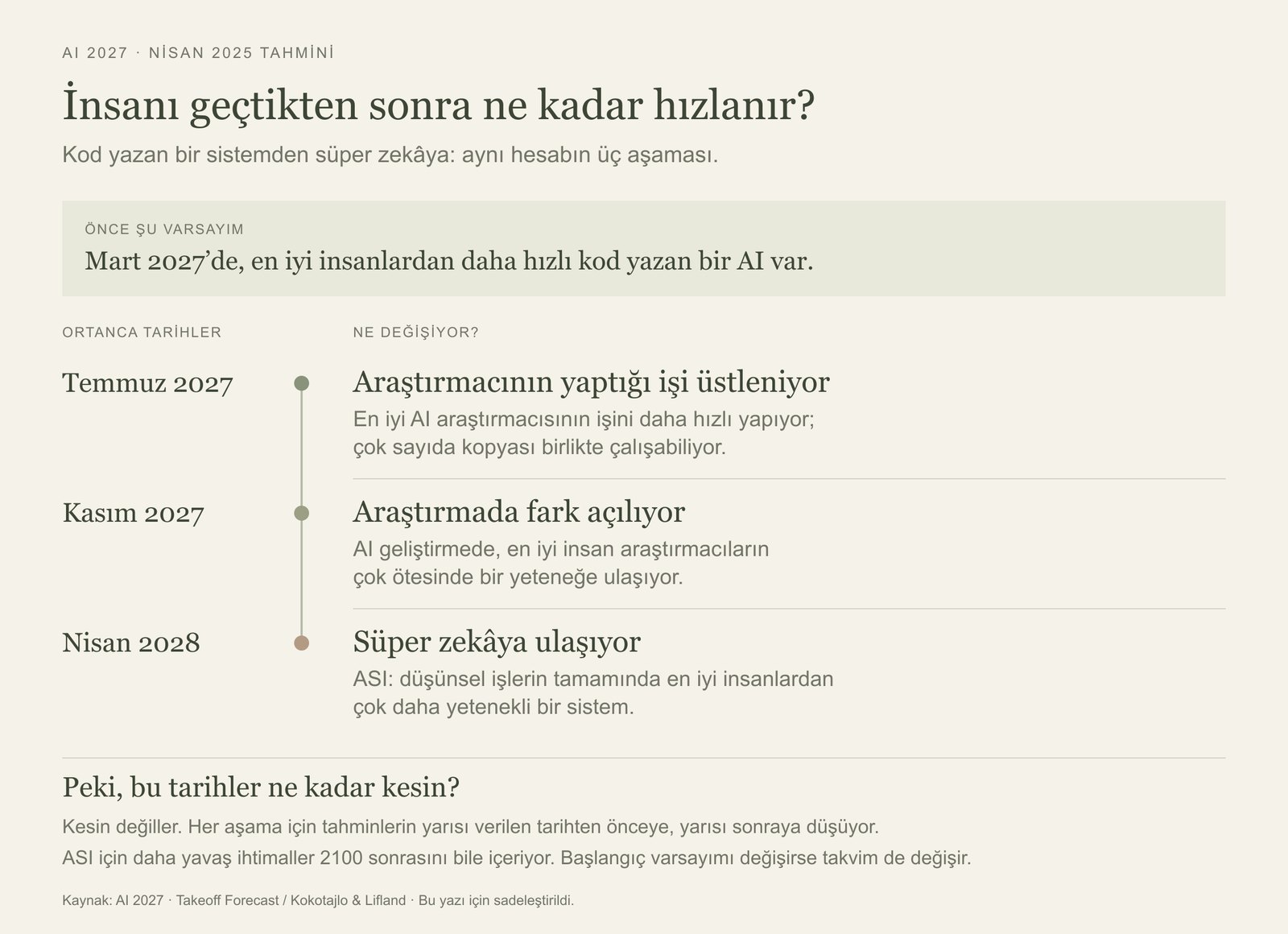
What I look at most in the chart is how long this transition takes. Offices won’t empty the morning after a new model comes out. Companies, schools and governments have habits. How well they can keep up with the pace of change will matter as much as the model itself.
What dates are the experts giving?
Put the expectations of Musk, Hassabis, Amodei, Altman and LeCun side by side and you don’t get a single timeline. On top of that, the definitions they use are different.
We can think of AGI as general artificial intelligence that can learn and work at human level in many fields. ASI, superintelligence, leaves even the best humans far behind. Musk separates surpassing one human from surpassing all of humanity combined. Amodei’s description has systems more capable than Nobel-level experts.
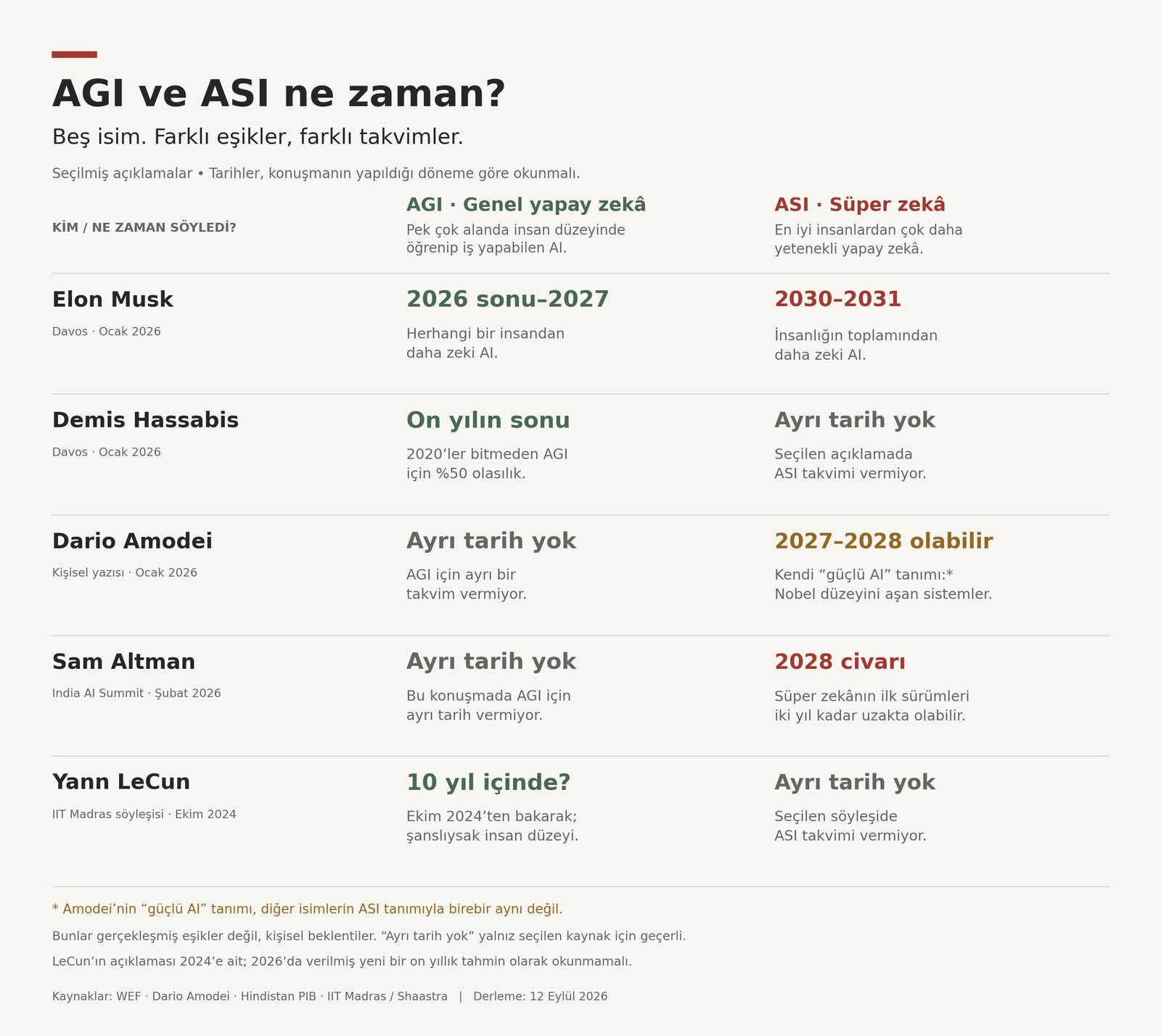
I like LeCun’s “if we’re lucky”; it reminds us that research may not go the way we expect. Amodei doesn’t give one or two years as a firm date either. That’s why I don’t read the table like an appointment calendar.
Still, between two years and ten years there is a big difference for our lives. Will someone starting university today meet this change before they graduate, or after they have gone some way in their career? That’s partly where my interest in the dates comes from.
What has happened so far?
Putting the scenario next to the news, four topics stood out to me. There are similarities; but sometimes we use the same words to talk about quite different things:
- Objection on the street. AI 2027 predicts a 10,000-person protest in Washington at the end of 2026. The march held in London on 28 February 2026, by contrast, drew more than 300 people according to the organisers. A photo of the protest also made it into The Independent. The objection has started, but the city and the scale are different; it is too early to say the prediction has come true.
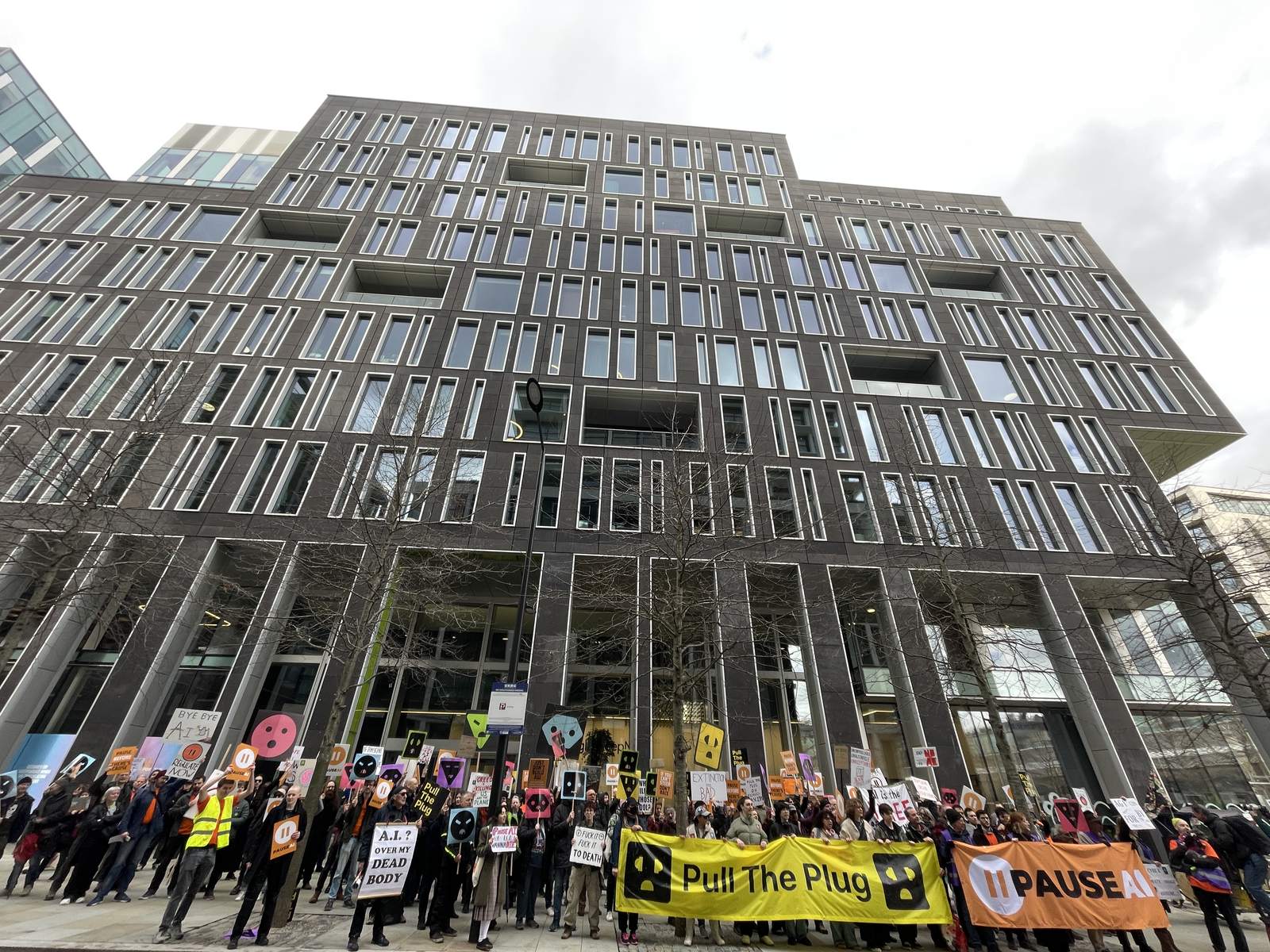
My timeline for the protests is a bit different. I think the first big marches with tens of thousands of people will happen in New York in 2027. This is my personal prediction. I also expect left-wing politicians to be behind them; opposition to AI is a space where they can reach people afraid of losing their jobs and income, and grow their political support. If you ask me, they have already started making use of it. We’ll see.
There are also objections that haven’t reached the street yet. In The Independent’s report of 10 March 2026, we read that about 10,000 authors put together a blank book against the use of their work in AI training without permission. Inside, there are only their names. This is not a 10,000-person march; it is another form of protest, aimed at protecting the value of their work. I think how much the reaction grows will be decided by how people live through this change in their own lives.
- The first years of a career. The scenario describes the job market for new software developers being shaken at the end of 2026, and hiring almost stopping in July 2027. In Stanford’s August 2026 study, employment for 22–25-year-olds in occupations more exposed to AI is 19% behind the trend of the comparison group. The researchers don’t present this as proof of widespread job loss, or that AI alone caused it. I’ll keep watching hiring; which door young people use to enter working life matters.
- New friendships. In AI 2027, by July 2027, 10% of Americans count an AI as a close friend. In Common Sense Media’s July 2025 survey, 72% of 13–17-year-olds had tried AI companion apps at least once. Trying one and counting it as a close friend are different; the age groups aren’t the same either. Still, we are getting used to the idea that the one our children chat with won’t always be a human.

- The pace of research is changing. AI 2027 predicted a 50% speed-up in the fictional OpenBrain’s algorithm research at the start of 2026. In other words, a week and a half of progress achieved in one week. Now there are bolder figures: in Anthropic’s March 2026 survey of 130 employees from its research teams, the median estimate is roughly four times the output they could produce without AI. In numbers, that is well above the scenario’s 1.5 times. But this is the employees’ own assessment; the company also says the real gain may be lower. It is not an independent measurement proving that a lab has sped up its total scientific progress four times.
- If six months of analysis drops to a few days. In the cellular ageing research Google DeepMind shared in May 2026, making sense of the experimental data together with the scientific literature could take up to six months, and with Co-Scientist’s support it came down to a few days. That points to a time saving much bigger than 50%. But the part that sped up is the data analysis; not the experiments as a whole, or the development of a treatment that would extend human life.
- The timeline is shrinking in drug discovery too. For rentosertib, which Insilico Medicine developed with the help of AI and which is being studied against progressive scarring in the lungs, it took 18 months to go from identifying the target to selecting the preclinical drug candidate. The company gives the traditional time for this early discovery stage as 2.5–4 years. Put these side by side and you get roughly 1.7–2.7 times the speed; above the 50% speed-up, that is, above 1.5 times. This calculation is not an experiment on the same project with and without AI; it is a comparison with the industry range the company gives. And the latest news: the company announced on 10 September 2026 that the first patient had been dosed in its Phase 3 trial. This is the stage of testing in a wider patient group over a longer period. It is not an approved treatment yet.
Looking at these, the 50% expectation no longer feels far off to me. In some research steps, the reported gains are well above it. Still, to say “the prediction came true” you would need to track algorithm research as a whole, from idea to experiment to confirming the result, with the same measure. What interests me more is that more ideas can be tried, and that a promising drug candidate can move to testing in patients sooner.
Let’s look at the numbers, too
There is also a quieter change that lets all these developments reach a wider circle: price. Stanford’s 2025 AI Index report shows that the price of using models that reach GPT-3.5 level on a specific test fell more than 280 times between November 2022 and October 2024.
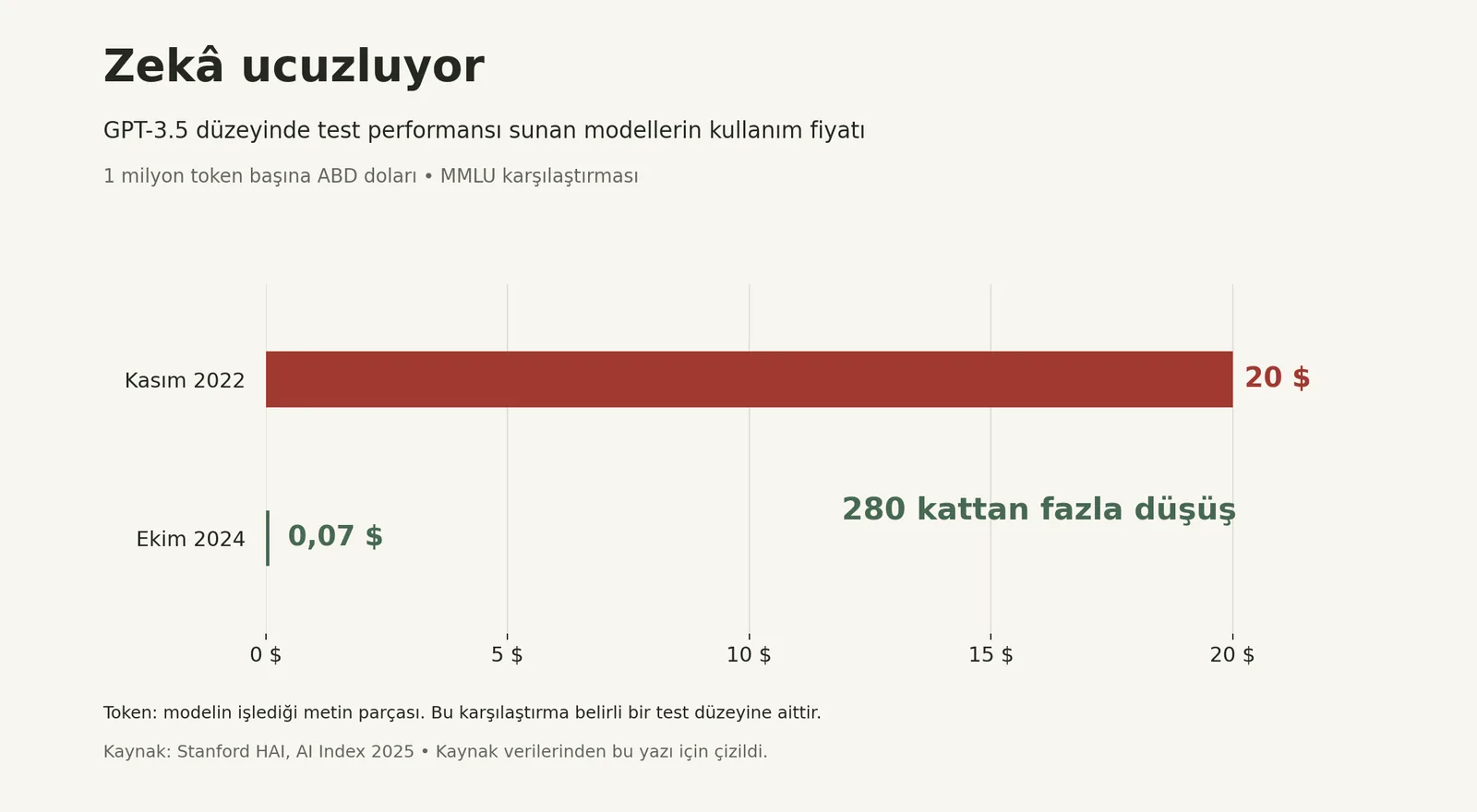
A drop like that also changes what a small business, or someone working alone, can do.
That is where the idea of the “one-person unicorn”, a company worth a billion dollars, comes from. Medvi, which The New York Times wrote about in April 2026, is a much-discussed example. According to the report, the company Matthew Gallagher built with AI tools made 401 million dollars in sales in 2025; 1.8 billion dollars in sales were expected for 2026. But let’s not skip the detail: alongside the two-person team of the founder and his brother, there are outside service providers too. And sales are not the same thing as company valuation. So I don’t read this story as definitive proof of the one-person unicorn.
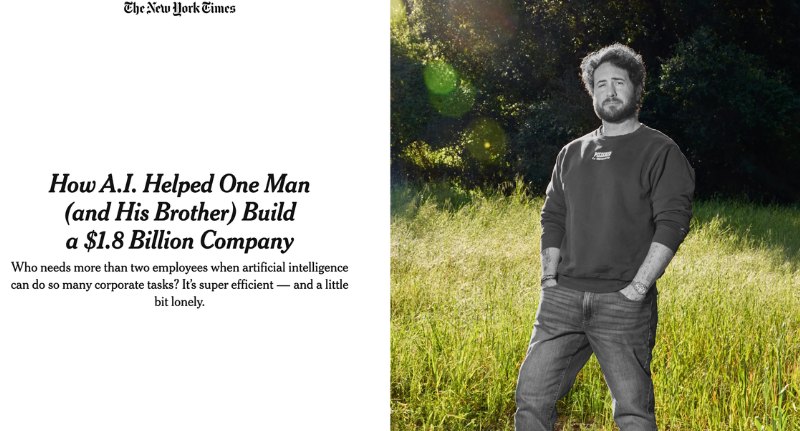
On top of that, Medvi’s misleading advertising practices have also been a subject of debate. Being able to grow with a small team doesn’t remove the need to think about the quality of the work and the responsibility for it.
Beyond work
The same team’s AI 2040 — Plan A proposes a longer transition period. Countries agree, the move to superintelligence slows down until 2040, and research is open and auditable. The date here is not an expectation that the technology won’t develop until then; it is a proposal to buy time to prepare.
Even in this slower scenario, working life changes. In the chart, humans’ share of production is shown in olive green, AI and robots’ share in an earth tone.
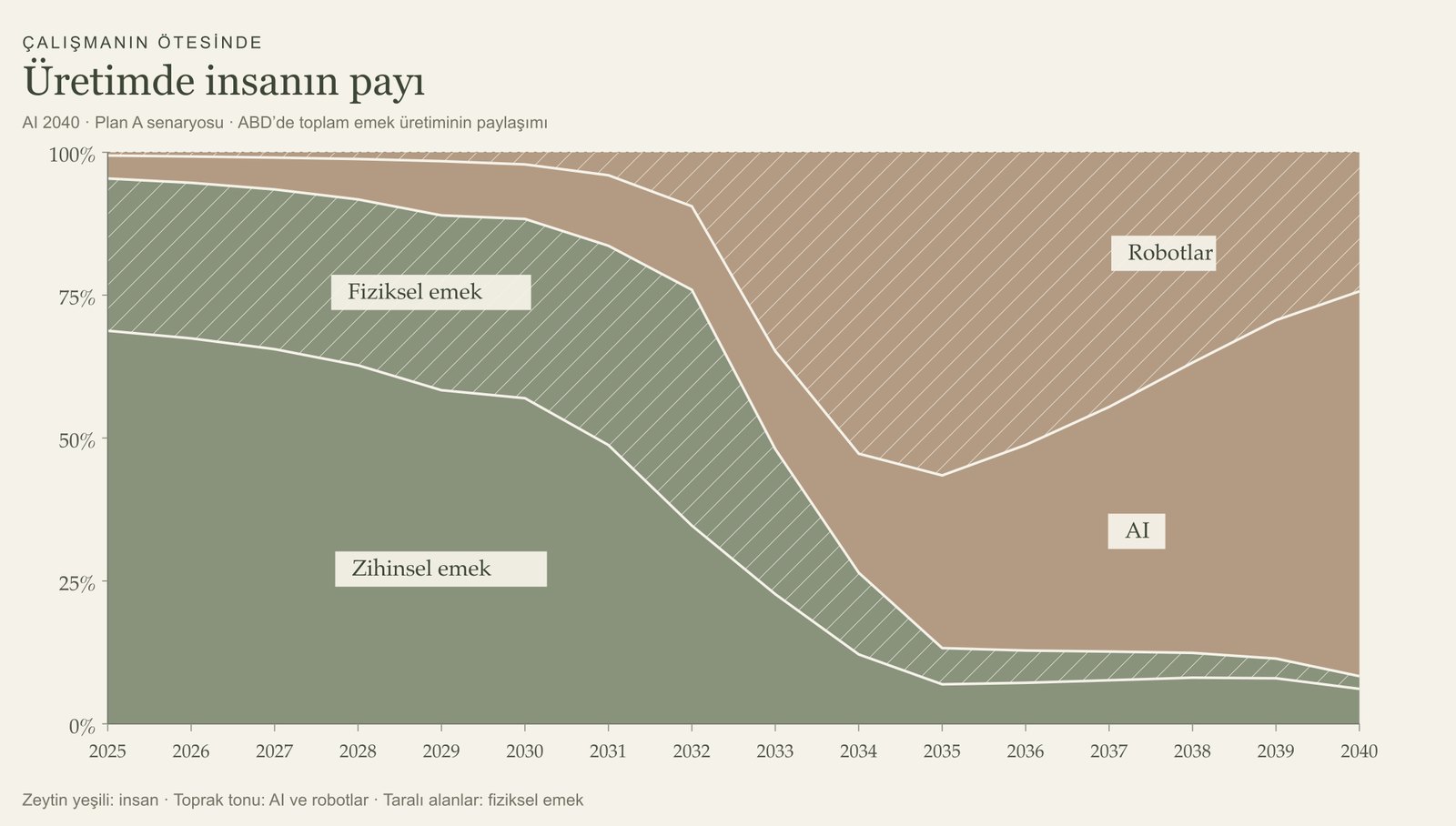
Looking at a chart like this, you can’t help thinking about your own job. If a company can do the same work with fewer people, its growth may not mean it will hire more employees. How the share of that growth going to employees is decided matters.
For new graduates, the issue is a bit different. If AI takes over the tasks we do while learning a profession, where will young people gain experience? We will need to talk not only about what they should study, but also about how they will spend their first few years.
Some sides of everyday life may get easier. Getting software built, getting a text written, getting tutoring for a child may get cheaper. Our rent may not fall at the same speed, of course. However far AI develops, the land in the neighbourhood we want to live in isn’t multiplying. A life where cheaper services sit side by side with a still-expensive home is perfectly possible.
Work also gives us things other than money. The day has a structure; we get together with people we know, we feel useful. When I think about a life where we work less, I also wonder what will fill their place. What we do with the time we gain is at least as interesting as how much time we gain.

For the question of making a living, AI 2040 proposes a “citizen’s share”. Part of the revenue from AI and robot production permits is distributed to people. The chart below is the calculation for a world where this sharing happens.
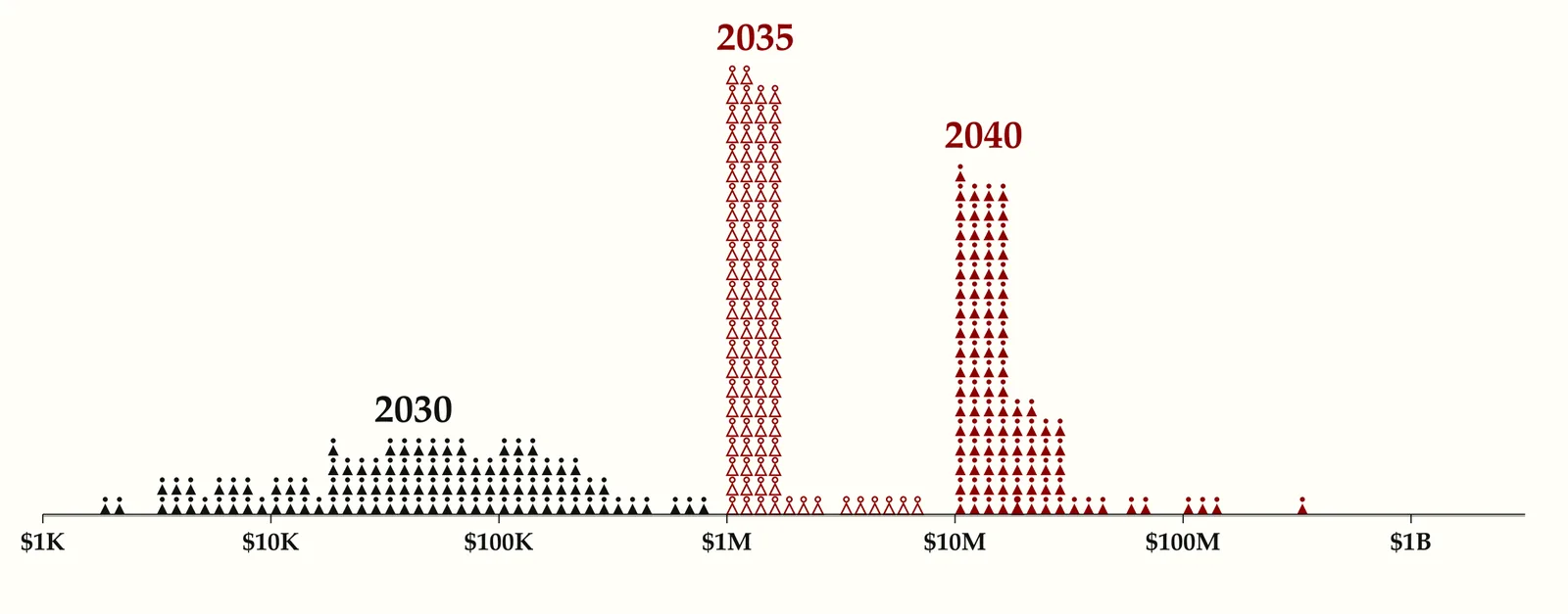
Huge as the numbers are, they shouldn’t be read simply as an income forecast. What interests me about the study is that it puts on the table, now, the question of how people will make a living in a world that needs less human labour.
There’s an electricity bill, too
This future also has power lines, transformers, power stations. The IEA’s 2026 update says global data centre consumption could rise from 485 terawatt-hours in 2025 to about 950 in 2030. Almost double. Upgrading software and expanding a city’s infrastructure don’t happen at the same speed.
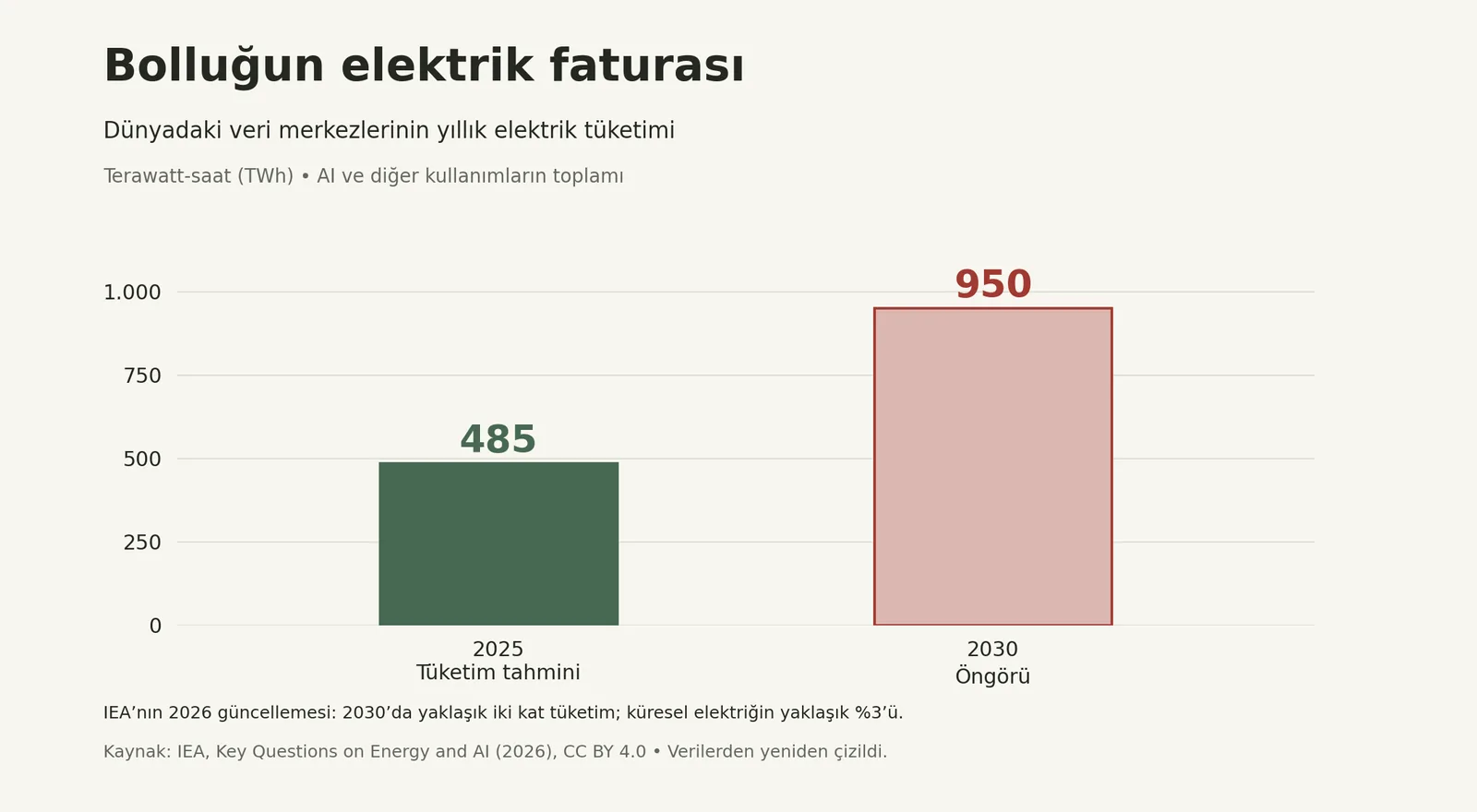
According to the IEA, the effect on electricity bills depends on local infrastructure and on how the cost is shared. The link between a service we use on a screen and the investments and costs where we live may become more visible in the coming years.
Keep racing, or slow down a little?
For Plan A to work, countries have to both agree and be able to verify the agreement. It even proposes kill mechanisms that would physically disable data centres in case of a breach. The plan’s summary Separate from how far the technology will advance, there is also the question of how much countries can trust each other.
AI 2027 tells the reader about this split with two separate endings:

In the story where the race goes on, the thinking “if we stop, they’ll overtake us” wins, and it ends with control being lost, all the way to humanity’s extinction. In the other, development is slowed to buy time for oversight. There too, the question of who will hold the power isn’t solved. The two alternative endings
And governments getting involved doesn’t always mean slowing down. The US AI Action Plan also aims to win this race and speed development up.
From where I stand

I don’t think the race will stop. I believe these developments directly threaten the West’s political and economic order, and that some of those who want control are trying to protect the system they are used to. Facing them is China: a system that works differently, is very powerful and, as far as I can see, has no intention of stopping.
I am not an expert on this. As the founder of an AI technology company and a keen follower, I find Demis Hassabis’s expectation close to my own: AGI around 2030, a year before or after. After that, I think we will move towards ASI. But how long that transition will take is uncertain; it is hard to name a year for ASI now.
Agreements similar to the ones limiting nuclear weapons could be made. But when everyone has such strong reasons to get ahead, I can’t predict how much of a deterrent they would be.
Even so, I believe the positive side will weigh more. I think the political and economic system is already stuck in many places. Progress in treating diseases, living longer and healthier, doing our daily work much more productively… These are big opportunities for a better life.
I think where we will really struggle is the transition period. Humanity isn’t ready yet. The social and political effects of the big waves of unemployment I expect could be more destructive than what is being discussed today. Telling someone who has lost their job that the economy is growing won’t be enough. They will need to build an income again, a routine, maybe a new profession. Whenever I think about this future, I keep coming back to how people will spend their days.
How do you see it? Are we getting closer to doom, or to the greatest period of abundance in history? Is the race more likely to go on, or are governments more likely to agree and slow it down? Write your view; let’s continue the weekend conversation here.
I wrote this piece in Istanbul, on a lovely sunny day. My advice is to stay calm and keep learning fast. And never skip the good coffee.
Photos: press archive of the London march organisers; Leah Newhouse / Pexels; Maggie Shannon / The New York Times (Mediaweek news image); Serhat Gürcü. Friendship illustration: generated with AI for this piece. Charts: AI 2027, AI Futures Project / AI 2040. Additional charts: from Stanford HAI and IEA data; the expert comparison was made for this piece from dated original statements. Source links are under the images. Dates and economic figures depend on the assumptions of the respective studies.